
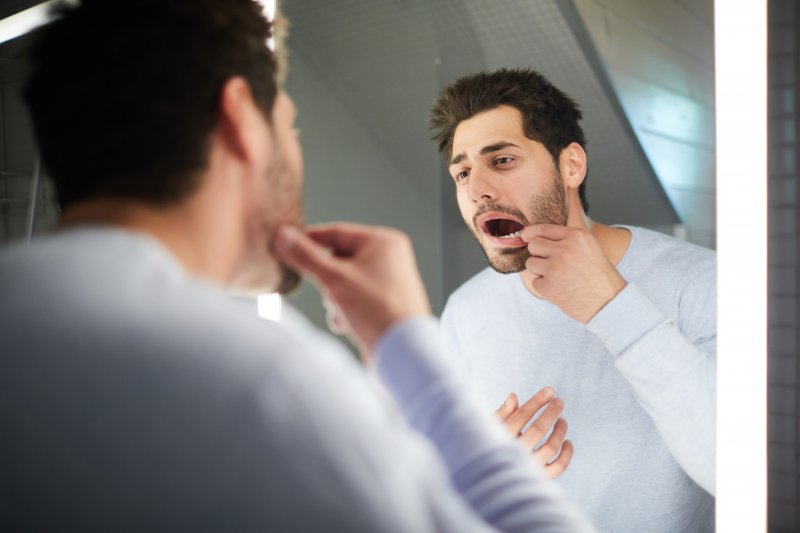
Oral cancer takes a life every hour in the United States. It’s a sobering statistic—and one that may make you wonder whether there’s something you can do between dental visits to reduce your risk. While at-home screenings aren’t the same as professional ones, they can still be beneficial if you know what to look for. Here’s what a home self-check can and can’t tell you.
What Is an Oral Cancer Screening?
An oral cancer screening is a meticulous examination of your mouth, throat, and surrounding tissues to find any abnormalities. Early detection is one of the most important factors in successful treatment, which is why both at-home awareness and professional screenings are a good idea.
What You Can Do at Home
A monthly self-exam is a good habit to build if you want to increase your chances of spotting warning signs. Here’s what to look for:
- Unusual sores or ulcers that don’t heal within two weeks
- Red or white patches on your gums, tongue, cheeks, or roof of your mouth
- Lumps, thickening, or rough spots anywhere in your mouth or throat
- Persistent hoarseness or a feeling that something is caught in your throat
- Numbness or tenderness in your mouth, lips, or face without obvious cause
To do a basic self-check, use a mirror and good lighting. Look at and feel all surfaces of your mouth — including under your tongue, along your gum line, and inside your cheeks. You should also check your neck and jaw for any swollen areas or unusual lumps.
What You Can’t Do at Home
A self-check raises awareness, but it has a lot of limitations. Many early-stage oral cancer lesions are easy to miss with an untrained eye. Many times, self-assessment sees these as minor irritation.
Professional screenings use advanced imaging devices, like intraoral cameras, to examine your mouth in detail, finding issues that might not be readily visible.
Your dentist also brings clinical context that you likely won’t have. They know what a suspicious lesion looks like versus a harmless sore, and they’ll know when to refer you to a doctor for further evaluation.
Self-checks are a habit worth building, but they’re a supplement to professional care—not a replacement. If you notice anything unusual during a self-exam, call your dentist and schedule an appointment. Many times what you find will be harmless but given the statistics it’s always better to be safe than sorry.
About The Author
Dr. Michael O’Brien is a talented dentist with a DMD from the University of Las Vegas Nevada School of Dental Medicine. He’s board-certified in Integrative Biologic Dental Medicine and a proud member of the IAOMT. At O’Brien Dental Wellness Center, Dr. O’Brien takes a holistic approach to care, keeping your mouth—and your body—strong and healthy. Call (918) 477-9000 to schedule your appointment today.